
Scotland County Court Records After Arrest
After a Scotland County arrest, the first public record may be a custody entry in the sheriff's Southern Software Citizen Connect roster. That entry is a booking record. It can show the name, booking photo, arresting agency, arrest date and time, bond total, and charge text held by the jail system. It is not the final court record. Formal court records after a jail arrest are handled through North Carolina courts, the Scotland County Clerk of Court, and the prosecutor's filings in district or superior court.
The usual sequence is arrest, transport to the Scotland County Detention Center, booking, a magistrate or other judicial official setting release terms, first appearance, prosecutor review, and court case activity. The Scotland County jail inmate records page is the better fit for current custody and booking status. Booking photos and roster image fields are covered on the Scotland County jail mugshots page. Court records after an arrest focus on the case: file numbers, charging documents, charge status, bond orders, hearing dates, judgments, and dispositions.
The practical point is simple. Jail charges can change. A roster card may use shorthand such as WFA for warrant for arrest or OFA for order for arrest. A prosecutor may decline a count, amend the charge, reduce a felony to a misdemeanor, seek an indictment, or add a related count. The court record is the place to confirm what the State filed and what happened next.
Find Scotland County Court Records
The North Carolina Judicial Branch Scotland County page is the local starting point for court dates, calendars, courthouse information, and official court links. The Judicial Branch also provides court-record guidance for public terminals and paper files. For a criminal case after a jail arrest, the strongest search fields are the defendant's name, the case number, and Scotland County as the county filter when the tool allows a county choice.
For in-person searches, the Judicial Branch court-records guidance says criminal case information can be searched at a public self-service terminal at a clerk of court office. A user may search criminal cases by defendant name, case number, or victim or witness name. Paper files are requested at the clerk's office in the county where the case is located. Scotland County Clerk of Court is listed at 517 Peden Street, Laurinburg, NC 28352, with phone 910-266-4400.
| Search Field | Where Used | Best Use | Notes |
|---|---|---|---|
| Defendant name | Portal or public terminal | Start when no case number is known | Use full legal name and check spelling variants. |
| Case number | Portal, notice, or terminal | Most precise court-record search | Copy it from a citation, warrant, indictment, or notice. |
| Victim or witness name | Clerk public terminal | Terminal search at a clerk office | Listed by Judicial Branch guidance for criminal case access. |
| Attorney name or bar number | Hearing search | Find hearings tied to counsel | Useful when a lawyer has appeared in the case. |
| Judicial officer or courtroom | Hearing search | Calendar and hearing review | Works best after the case has reached a scheduled hearing. |
| County | Court-date or location filter | Narrow to Scotland County | Use when a name search returns statewide matches. |
The public terminal route matters because some details may be clearer there than on a general web search. It is also the better path for older court records, paper-file review, certified copies, and cases with common names. If a case appears to be sealed or unavailable, ask the clerk which portions are public rather than relying on the jail roster as a substitute for court status.
The Judicial Branch court-record help page is the source for public terminal and paper-file access.
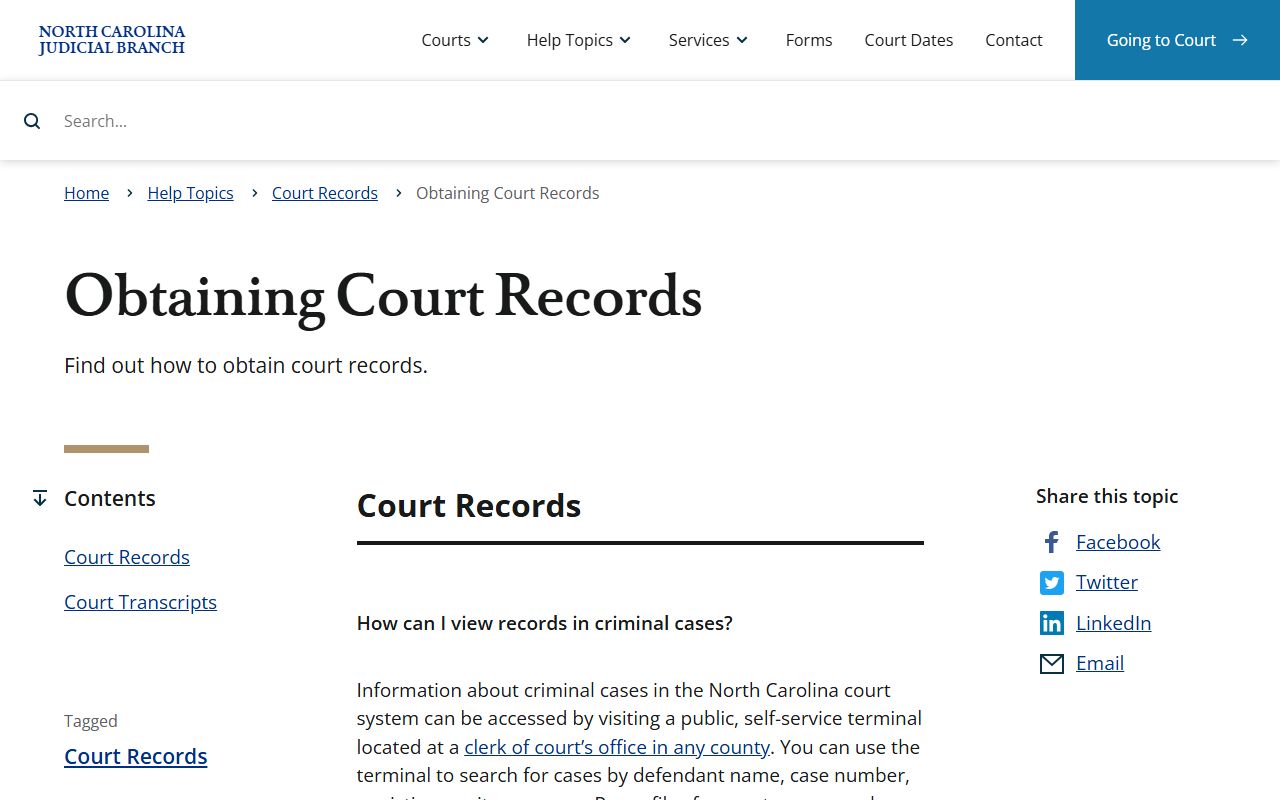
That source helps separate formal court lookup steps from the jail roster fields that appear right after booking.
Scotland County Charging Documents
Charging documents are the bridge between an arrest and the court record. A law enforcement officer may begin the process through a warrant, citation, or complaint tied to the arrest. The District Attorney then reviews criminal cases filed in the district and decides how to proceed. Scotland County is in Prosecutorial District 21 with Anson and Richmond counties. Jamie Adams is identified in the research as the current district attorney, and the district attorney's listed duty is to prosecute criminal cases filed in the district.
North Carolina court records after a Scotland County jail arrest can involve different charging forms depending on the offense level and stage. The terms below are not a promise that every case will use each form. They are a way to read what appears in a court file after the jail booking has already occurred.
| Document | Who Uses It | Common Role | What to Check |
|---|---|---|---|
| Complaint | Officer, magistrate, or prosecutor | Starts or supports the charge after arrest | Alleged offense, date, officer, and process type. |
| Information | Prosecutor | Prosecutor-filed charge in some criminal contexts | Filed count, offense level, and any waiver or plea context. |
| Indictment | Grand jury | Superior court felony charging document | True bill date, counts, statutory offense, and superseding changes. |
Do not assume the jail charge text is the charging document. Citizen Connect can show charge strings and bond lines, but court records separate the case into file numbers, formal counts, hearings, and dispositions. That is why a Scotland County court records after arrest search should compare the roster charge with the clerk record before treating a count as the active charge.
Scotland County Charge Status
Charge status can shift many times between booking and judgment. The jail roster may still show the initial charge text, while the court record may show an amended charge, a dismissal, a superseding indictment, or a plea to a different offense. A dismissed charge is not a conviction. A pending charge is not proof that the person did the act. A judgment is the final court action after plea, trial, dismissal, or sentencing.
| Status | Plain Meaning | Where to Confirm |
|---|---|---|
| Pending | The case or count remains unresolved. | Court portal, clerk terminal, or clerk office. |
| Amended or reduced | The prosecutor changed the offense, count, or level. | Court case events and filed documents. |
| Dismissed | The prosecutor or court ended that charge. | Disposition field or filed dismissal. |
| Indicted | A grand jury returned a felony charging document. | Superior court case record. |
| Judgment | The final outcome after plea, trial, dismissal, or sentence. | Judgment and disposition records. |
Scotland County court records after a jail arrest are especially important when a roster card contains shorthand. WFA usually means warrant for arrest, and OFA usually means order for arrest. Those labels explain how a person entered custody, but they do not give the full case outcome. The court record supplies the next hearing, filed counts, and final disposition.
District Attorney Charge Review
The District Attorney's office is not the jail. The sheriff books and holds people at the detention center under court authority, while the District Attorney represents the State in criminal cases. Research for Scotland County identifies Prosecutorial District 21 as the district for Scotland, Anson, and Richmond counties. The North Carolina Conference of District Attorneys describes the DA's primary duty as prosecuting criminal cases filed in the district, preparing criminal trial dockets, and advising law enforcement officers.
That role explains why court records after a Scotland County arrest may not match the first jail entry. The booking card can show what the arresting agency brought to the jail. The prosecutor can screen that record, file formal charges, reduce or amend a count, seek indictment, dismiss a charge, or proceed to plea or trial. For the user, the custody record answers whether someone was booked. The court record answers what the State filed and what the court did with it.
Note: The research did not locate a Scotland-specific DA street address, so use the district DA page and court clerk routing for official contact steps.
Bond Conditions After Arrest
Bond is part of the court pathway, even when a bond total also appears on a jail roster card. North Carolina G.S. 15A-534 governs pretrial release conditions. A judicial official may use unsecured appearance bond, custody release to a supervising person or organization, secured appearance bond, cash deposit, mortgage or surety, or house arrest with electronic monitoring. The release order is filed with the clerk and a copy goes to the defendant and any surety.
Scotland County roster records can show bond totals and per-charge bond lines, including secured bond when available. The public research did not find an online bond-payment portal or bond counter schedule for Scotland County. For release questions, use the jail at 910-277-3166 and the Clerk of Court at 910-266-4400. A release can still be blocked by another county hold, an order for arrest in another case, probation or parole action, state prison commitment, a federal hold, or an ICE detainer process.
| Release Term | How It Works | Record Location |
|---|---|---|
| Unsecured bond | The defendant signs a promise and owes money only if terms are broken. | Clerk release order. |
| Secured bond | Cash, property, or surety backs the bond amount. | Roster bond line and court file. |
| Custody release | A person or organization agrees to supervise release. | Court release order. |
| House arrest | Electronic monitoring may be added as a release condition. | Court order. |
| No-bond hold | Release is blocked until a judge or other authority changes the hold. | Jail status and related court process. |
Warrants and Criminal Papers
Scotland County does not appear to publish a complete active-warrant list on the main sheriff website. The sheriff does provide a Citizen Connect Criminal Papers Search with first, middle, and last name fields. The research treats that tool as an official criminal-papers search, not as proof that every active warrant is public there. Citizen Connect also has a Most Wanted page, but that is a highlighted law-enforcement notice page, not a full warrant database.
When a warrant, order for arrest, or bench warrant leads to a booking, the jail roster may show WFA, OFA, probation-violation text, the arresting agency, and the arrest date. Returned warrants and indictments can become public court records unless sealed under North Carolina law. A search warrant is different. It authorizes a search and does not always mean a person has been booked into Scotland County jail.
| Criminal Papers Field | Type | Use |
|---|---|---|
| First Name | Text | Optional name search field. |
| Middle Name | Text | Useful for common names. |
| Last Name | Text | Main name field for a criminal-papers search. |
| Submit | Button | Runs the Citizen Connect name search. |
Charges vs Convictions
A charge is an accusation filed in the criminal process. A conviction is a final result after a guilty plea, verdict, or other qualifying disposition. Scotland County court records after an arrest should be read with that distinction in mind because early jail and court records often list accusations before the case has been tested in court.
| Point | Charge | Conviction |
|---|---|---|
| Stage | Begins the criminal accusation. | Comes after plea, trial, or final judgment. |
| Proof level | Based on probable cause or prosecutor filing. | Requires legal proof or an admitted plea. |
| Where it appears | Roster text, warrant, citation, indictment, or case record. | Judgment and disposition record. |
| How it changes | May be amended, reduced, added, or dismissed. | Changes only through later court action. |
Sealed and Expunged Records
North Carolina public-record law does not make every criminal record open in every form. G.S. 132-1 broadly defines public records. G.S. 132-1.4 limits criminal investigation records but preserves access to certain arrest information, including the name, sex, age, alleged violation, and circumstances of the arrest unless another law applies. Returned arrest warrants and indictments may be public unless sealed.
Expunction is a court process, not a website removal request. North Carolina G.S. 15A-145.5 can apply to certain nonviolent misdemeanors and felonies when eligibility requirements are met. Scotland County research did not locate a sheriff policy promising automatic roster-photo or booking-record removal after dismissal, acquittal, release, or expunction. Court orders and the originating agency control the result.
| Point | Sealed Record | Expunged Record |
|---|---|---|
| Public visibility | Hidden or limited by law or court order. | Cleared through a court process when eligibility is met. |
| How it happens | A judge or law restricts access to the record. | An expunction petition and order control the result. |
| What to request | Ask the clerk what portions, if any, can be released. | Use the expunction order and the originating agency's instructions. |
| Scotland County caveat | Investigative material may still be withheld under G.S. 132-1.4. | No sheriff policy promising automatic roster-photo removal was located. |
Restricted Scotland County Court Records
Some court records after a jail arrest may be limited because the record involves a juvenile matter, a sealed case, an expunction order, victim information, confidential personal data, or active investigation material. The public roster also excludes many sensitive fields. The inspected Scotland County booking records did not show home address, Social Security number, driver's license number, phone number, victim data, medical status, or housing pod.
For background checks, separate casual public lookup from regulated screening. Court and jail lookup results are not consumer reports and cannot be used for employment, housing, credit, insurance, or any other FCRA-regulated purpose. For official court status, use the clerk, the Judicial Branch, or the originating agency.